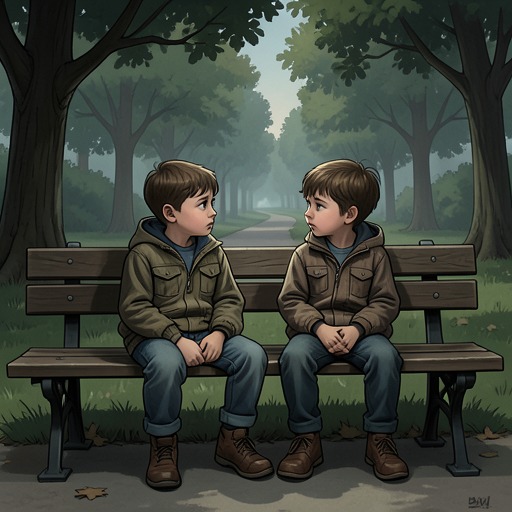
Eli’s ambiguous gender and age
Let the Right One InEli’s ambiguous gender and age are presented not as a puzzle with a hidden answer, but as a boundary Eli states and Oskar tries to understand. Eli says they are neither a girl nor a boy, neither a child nor old, and finally “nothing.” The conversations leave that self-description intact: Oskar may ask what it means, but their bond does not depend on settling Eli into a familiar category.
Identity and Boundaries
Eli first tests the place gender has in Oskar’s affection by asking whether he would still like them if they turned out not to be a girl. Oskar answers yes, though his “I guess so” makes his reassurance less certain than a simple declaration would have been. Eli presses him to confirm that he is sure. The exchange makes the question personal: Eli is not asking for a definition of gender in the abstract, but whether Oskar’s regard will survive a possible change in how he understands them.
When the subject returns, Eli is more direct. They say, “I’m not a girl,” but immediately resist Oskar’s assumption that this must mean they are a boy. Asked what they are instead, Eli first says “Nothing,” then expands that answer: “I’m nothing. Not a child. Not old. Not a boy. Not a girl. Nothing.” The sequence refuses the expected either-or choice and also unsettles the age distinction. Eli does not offer a third label to replace the two familiar gender categories; the repeated “nothing” rejects the demand to provide one.
The declaration is emphatic, but the evidence does not explain its origin or resolve what Eli’s identity might be beyond the words they use. The text therefore supports a precise distinction: Eli states that ordinary labels do not fit, while the reason and any further account of that experience remain unstated. The ambiguity belongs to the character’s expressed self-understanding, not simply to Oskar’s inability to guess correctly.
Oskar’s Questions and Their Limits
Oskar’s responses reveal both the limits of his understanding and his willingness to remain in the conversation. At first, he interprets “not a girl” as a choice between girl and boy, asking whether Eli means they are a guy. Eli rejects that alternative. Oskar then asks, “Then what are you?” His question repeats the pressure to name a category, but the answer does not satisfy that demand with another conventional identity. When Eli calls themself nothing, Oskar asks what that means rather than arguing that Eli must be something more easily recognized.
His response to the earlier question is similarly incomplete but important. “Yes … I guess so” is not polished certainty, and Eli notices the hesitation enough to ask whether he is sure. The scene does not turn Oskar into an authority on Eli’s identity: his uncertainty remains visible. What it does show is that he continues to engage, and later asks whether they can be together as they already are. His attention shifts from solving the category to preserving the relationship.
That shift is not the same as a complete understanding. Oskar initially asks Eli to explain themself in terms he can grasp, while Eli’s answers insist that those terms are inadequate. Their exchange lets both things stand at once: Oskar’s affection is real, and his vocabulary does not yet provide a neat account of Eli.
Together Without a Definition
When Oskar asks whether they might go out together, Eli answers that they would like to, but cannot, and asks whether they can simply remain together as they already are. Oskar agrees. The exchange leaves their connection without a conventional label for the relationship, just as Eli’s self-description has resisted conventional labels for gender and age. Eli’s suggestion is not a rejection of closeness: it preserves the existing bond while declining the form Oskar has proposed.
Eli also asks whether Oskar is sad and offers that they can kiss if he likes. The offer makes physical affection possible without resolving the earlier question. It does not establish why Eli says they cannot go out, nor does it transform Eli’s self-description into a romantic explanation. Instead, the scene distinguishes intimacy from classification: they can be together, and may kiss, while the terms of that togetherness remain unsettled.
The wording carries a quiet asymmetry. Oskar first imagines a recognizable step forward—going out—and Eli redirects him toward what is already shared. Their answer both limits and affirms: not that closeness is impossible, but that it need not take the form he named. The relationship is consequently portrayed as something negotiated between them rather than secured by assigning Eli a gender or age category.
The Question Beyond the Conversation
Elsewhere, Oskar asks a teacher whether someone can be “both girl and boy at the same time” or “neither.” The question echoes the alternatives Eli has refused, but it is posed as a possibility rather than a settled claim about Eli. The teacher begins to answer by distinguishing people from some kinds of animals; before the explanation develops, a pupil interrupts to complain that Jonny put snow down her back. The interruption leaves Oskar’s question without an answer from the adult, just as Eli’s own account has not been translated into a conventional explanation.
The scene places Oskar’s curiosity in an ordinary school setting, amid the routine claims on a teacher’s attention. After the girls arrive and report what Jonny and Micke have done, Oskar falls behind the group. He turns toward the two boys, who wave; he does not wave back, and instead takes a large branch and strips off its small twigs as he walks. The narrative does not say that this gesture answers his question about Eli, or that it is caused by that question. Its placement does, however, leave the inquiry suspended alongside the school’s social world, where identities and relations are not discussed in isolation from everyday encounters.
Across these moments, Eli’s ambiguity is not resolved by Oskar, the teacher, or a final explanatory label. The scenes instead make the uncertainty consequential: it tests the security of Oskar’s affection, complicates his proposed understanding of their relationship, and exposes the limits of the categories available in their conversations. What remains clearest is Eli’s refusal to be reduced to either side of a binary—and Oskar’s eventual willingness to be with them without requiring that refusal to disappear.